
Amy Grier, writer, singer, and pianist, discusses how writing helps connect her with her voice.
AMY GRIER – NONFICTION, JANUARY 2017
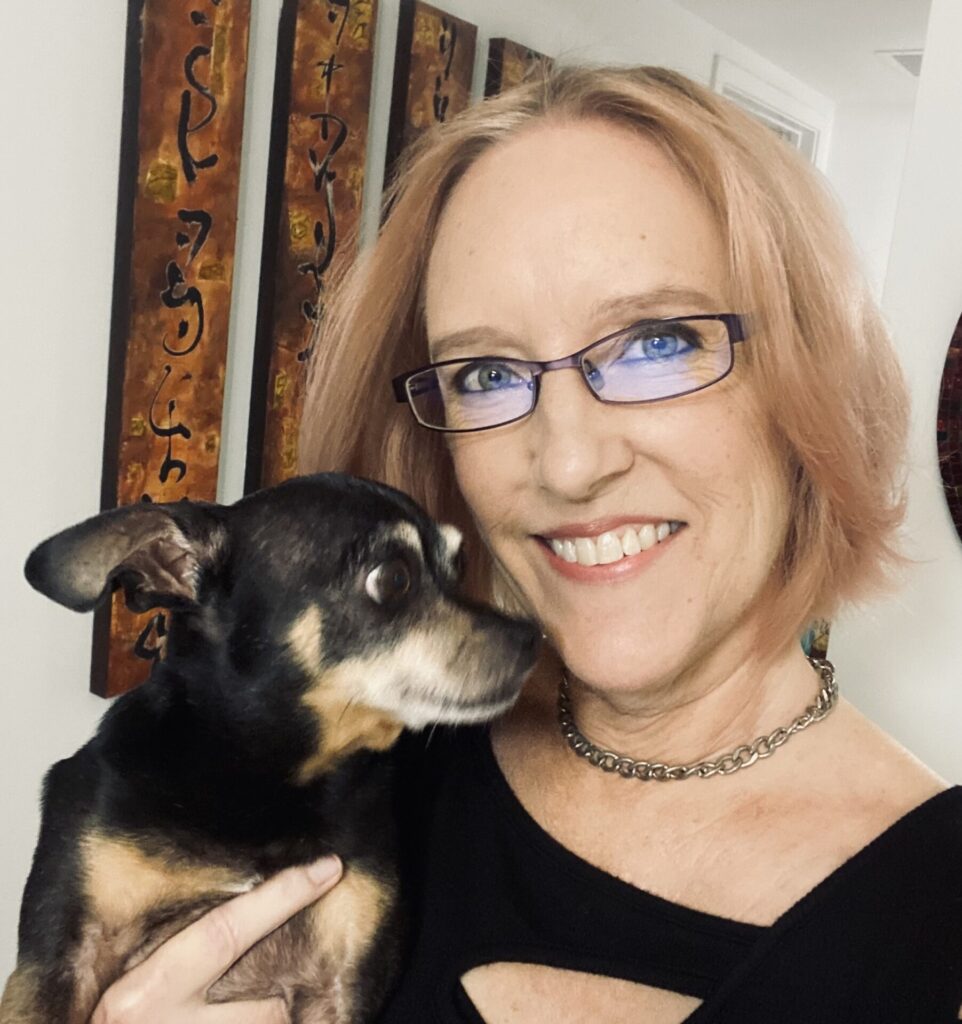
Amy Grier earned her MFA at Lesley University. A singer and classically trained pianist, she has taught music and English in the U.S. and Japan. Amy has a master’s in East Asian Studies from Washington University in St. Louis and one in Literature and Writing from Rivier University. Her prose and poetry has appeared in Solstice, Poetry East, the BrevityBlog, eratio, Streetlight Magazine, and others. Her memoir-in-progress, Terrible Daughter, is about the events leading to her estrangement from her parents.
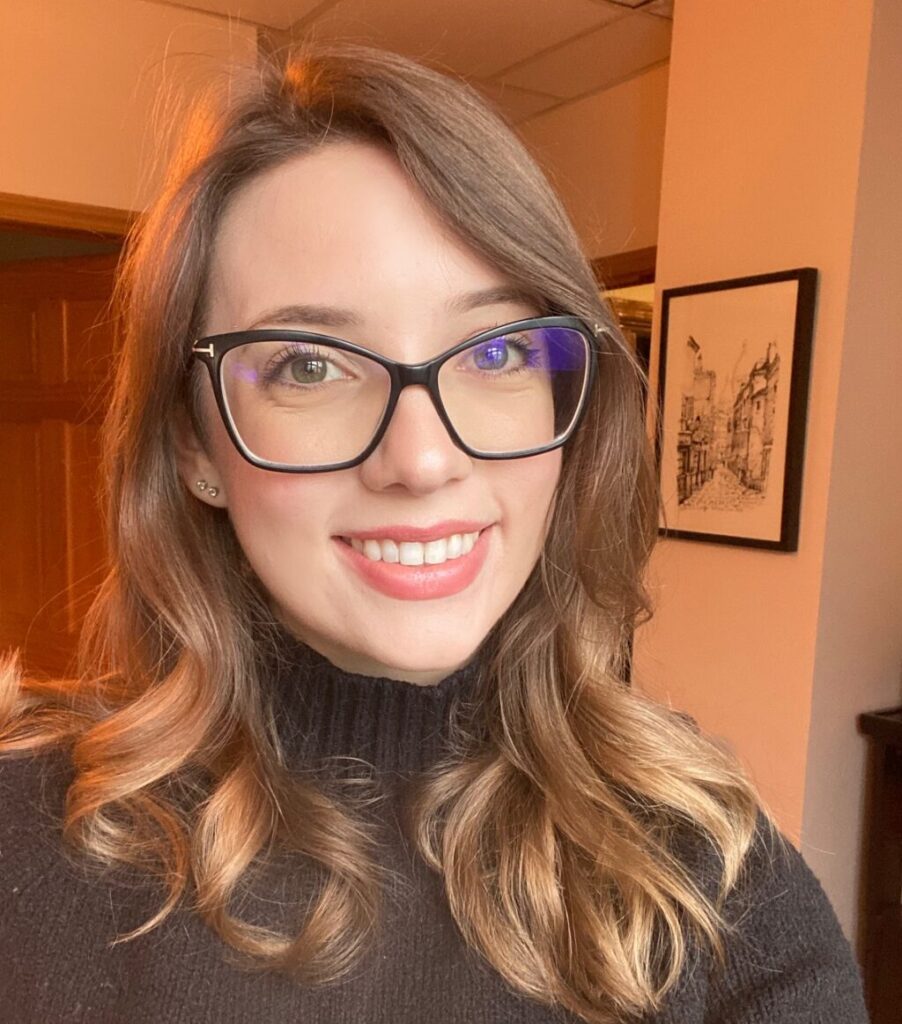
Interview by Holly Claytor
Holly Claytor: How did you first get into writing? Could you explain what writing means to you?
Amy Grier: I started writing stories and poems as a kid. Poems, in particular, became a compulsion during times that were emotionally difficult. I was a shy child with selective mutism and was raised in an environment that was frequently loud—a lot of fighting between my parents, a lot of abuse and anger and rage mixed with both control and neglect. I was frequently criticized for being quiet, for not “speaking up,” for crying, for laughing, you name it, I did it wrong. My voice felt full of danger and it scared me. Words on paper were safer, quieter, more private. So I put my voice there.
To me, writing means processing, both cognitively and psychologically. It means creating a shift internally and subconsciously that I can’t achieve any other way. It also means fear of uncertainty, confronting all the parts of myself, and trusting a process that I don’t truly understand. And writing allows me to connect with the world even when I’m all alone.
HC: What inspired you to earn an MFA, and what brought you to Lesley? Was there any moment from your time at Lesley that made a lasting impression on you?
AG: I completed dozens and dozens of workshops before Lesley, mainly during summers at the Fine Arts Work Center in Provincetown, in community classes, online with Gotham, anywhere I could find something that interested me. I asked many writing instructors if I should get an MFA, and every single one of them had no clear answer for me.
When I saw an Open House advertised for Lesley, just as I was beginning to work on a memoir, I saw it as an opportunity. I loved the whole vibe there—the support, the emphasis on craft, the community created by people who care about each other and cheer each other on. It’s the only kind of community I want to be connected to.
One moment I’ll always remember is sitting in a workshop with Rachel Manley as she, in the most earnest, passionate, and direct way, eviscerated a fellow writer’s essay. This writer was someone we all knew had written excellent essays, which is perhaps why Rachel felt she could be so direct about why it wasn’t working. The magical moment came when, just as Rachel finished her speech about “this skeleton of an essay” and all was quiet, someone said, “I feel like applauding.” Which was exactly how we all felt! Imagine someone being able to deliver all the reasons your writing doesn’t work and all of us—including the author of that essay—being so grateful to hear it, knowing she had just made us all better at our craft.
HC: I know you are also a musician – both a singer and a pianist. How do these forms of art compliment your writing life?
AG: I have a degree in voice and piano, classically trained, which feeds my perfectionism in both helpful and challenging ways. I still study voice and piano, each of which offer different kinds of growth and complement my writing life in different ways.
Voice will always be hard for me. Although I’m an accomplished singer, I still work on disengaging throat tension—a protective habit left over from my childhood when anything I said could result in punishment. I still work on speaking up loudly enough to be heard. I still work hard to express my own thoughts with confidence and respect for the thoughts of others. And this spoken voice of mine is intertwined with my writing voice. In both cases, I struggle to believe that what I’m saying/writing is good, that it matters, that I deserve to take up space with my voice. This continues to be a difficult challenge for me, and it’s helpful to think of my voice in this layered context.
I also did a lot of theatre in high school and college, both plays and musicals, as well as musical directing and piano accompanying. I am so grateful for the skills I gained through theatrical performance that help me use and trust my voice and my body. All art feeds every kind of art.
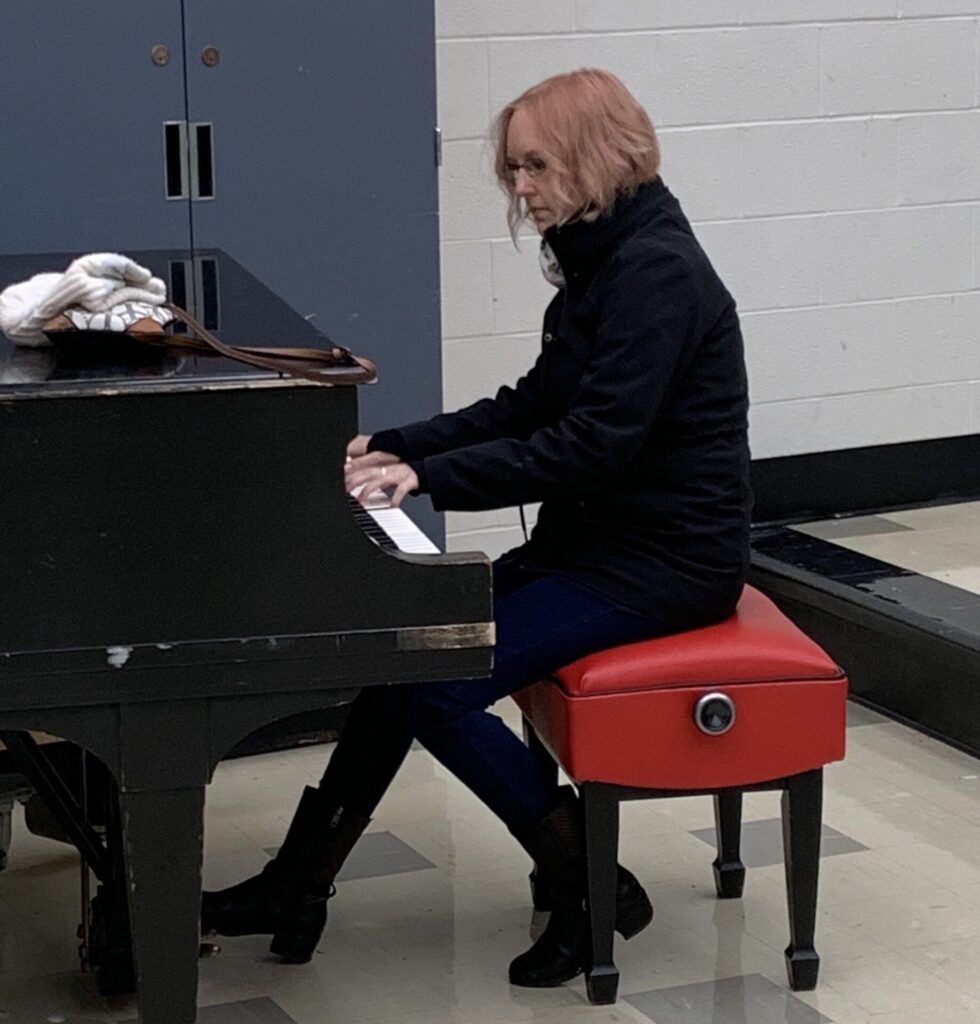
Piano—piano is refuge. I started playing when I was eight—my sibling calls my playing “the soundtrack of our childhood.” It is also part of my voice, and was the only noise I could make as a child that did not trigger my parents’ rage. Piano is where I can feel anything without judgment. It’s where I process loss and grief, especially through Chopin. I currently have a memorized repertoire of Chopin, Debussy, and Schumann, and there is no better writing break than sitting down at my most prized possession—a 5’7” Model M Steinway grand—and playing and playing and playing. I love it. And I’m proud of all I’ve accomplished as a musician in a way I’ve not yet experienced as a writer.
HC: Are there any particular themes you are drawn to in your art and writing?
AG: I love all the themes! I love writing analysis, I love literary theory, I love writing about writing. I earned two advanced degrees before my MFA—an MA in East Asian Studies at Washington University, where I focused on Japanese language and history, and an MA in Literature and Writing at Rivier University in Nashua. I credit my time at Wash U with really teaching me how to read and write and write about what I read. I loved it. I love sourced and researched writing. I love the whole process of digging through text and making connections and putting language to that process.
As for particular themes, I will always be fascinated by boundaries of all kinds. I remember writing a paper on Toni Morrison’s novel Jazz at Rivier where I identified and decoded the significance of boundaries—people standing on either side of a street, a curtain drawn or pulled back on a train, the border between Maryland and Delaware which signified stepping out of the brutality of the Jim Crow South.
And I’ll always remember the first time, in junior high school, when I identified a metaphor on my own. I was reading Orwell’s 1984 and was confronted with the ulcer on Winston Smith’s leg—it grows inflamed and painful in his Big Brother cell of a home, improves during his rebellion and affair with Julia, then worsens again after his torture and conversion. I still think about that ulcer.
HC: Are you working on anything in particular at the moment?
As a person with ADHD, I always have so many ideas all the time about what I want to write. Ideas are never my problem! Currently, I’m outlining ideas for a series of essays about living with chronic blood cancer. I’ve had polycythemia vera, a rare bone marrow disease caused by an acquired genetic mutation, for 35 years, and recently it has progressed to where I will likely need a bone marrow transplant in the next 1-2 years. Although I’ve written a lot about my disease, I’ve never published anything about it. Looking toward a risky but potentially life-saving transplant has lit a fire under me to share more about it. I’m incredibly proud of the life I’ve created for myself—a life of education, travel, curiosity, friendship, compassion, and art—despite a difficult medical history, a traumatic childhood, and being so physically challenged.
HC: I know you also write reviews. What makes this form of writing interesting for you?
AG: I love writing book reviews because they require textual analysis and I love textual analysis! It is a highly creative endeavor. I think people see literary criticism/review as a more intellectual or cognitive pursuit than creative writing, but it really isn’t. I have to bring all of my creative resources to bear when I write any review. Anything I write about deserves all the respect I can deliver by spending time with the author’s writing, finding the kind of connections I talked about earlier, and critiquing it in a way that allows the right audience for that book to find it. And, ideally, in a way that teaches the author something new about what they’ve accomplished.
HC: Writing reviews is a fantastic act of literary stewardship. What does literary stewardship mean to you?
AG: Writing reviews is literary stewardship. Purchasing and reading your peers’ work is also literary stewardship, especially if you take a moment to email or text a supportive response. None of us will ever get tired of that kind of support.
Ultimately, literary stewardship is showing up for your fellow writers and for writing itself in whatever ways you can. When I was Managing Editor at Solstice, I took the opportunity to get fellow Lesley alums on board as readers. And being a reader or working in any position at a litmag is stewardship. Volunteering for CCW. Attending open mics. Going to readings and book launches. Checking in on writing friends to see how they’re doing. Subscribing to writing friends’ newsletters. Telling friends about a book you love so they’ll buy it and read it. Standing up against book bans. Donating books anywhere they’re needed. Creating a Little Library.
There are so many ways to show up for writing. And that includes creating space for yourself and providing yourself whatever you need to write whatever it is your heart desires to write, trusting yourself beyond reason, and allowing your voice to be heard.
Amy wrote a piece on “The Art of the Book Review” for our Literary Citizenship page. Check it out here!
Comments are closed